
Maybe We’ve Been Asking the Wrong Question
For decades, the search for life on Mars has focused on a seemingly simple idea: go there and look for organisms. However, the results obtained so far have been ambiguous. Neither the robots sent to the Red Planet nor the experiments carried out since the 1970s have been able to clearly answer the big question.
Now, a group of researchers is proposing a different approach: instead of directly looking for life, we should study Mars’s chemical history through its organic molecules. According to the authors, understanding how these compounds form, evolve, and are preserved could be the key to knowing whether Martian life ever existed.
A Very Different Mars from the One We See Today
When we look at current images of Mars, it is hard to imagine it as a habitable place. Temperatures are extremely low, the atmosphere is very thin, and the surface is bombarded by intense radiation.
But it was not always this way.
Numerous geological lines of evidence indicate that more than 3.4 billion years ago, Mars was much more similar to Earth. Rivers, lakes, and even seas may have existed on its surface. A denser atmosphere would have kept temperatures relatively mild, and a magnetic field would have protected the planet from solar radiation.
In other words, during part of its history, Mars had many of the ingredients considered favorable for the emergence of life.
Organic Molecules Take Center Stage in the Search
When we talk about organic molecules, many people immediately think of life. However, not all organic molecules are biological.
In fact, organic compounds have been found in meteorites, comets, and asteroids without any need for organisms to produce them. The challenge is to distinguish molecules created by purely chemical processes from those that might be linked to biological activity.
The difference can be understood with a simple analogy.
If you dump a box of building blocks onto a table and leave everything to chance, you will end up with a jumble of shapes and sizes. But if those pieces are used to build a house, an organized pattern appears.
Something similar happens with molecules. Spontaneous chemical processes tend to generate chaotic mixtures. Living organisms, on the other hand, produce sets that are much more selective and ordered. That kind of “chemical preference” can leave recognizable traces even billions of years later.
Clues Found So Far
The search for organic compounds on Mars began in earnest with the Viking landers in 1976.
At the time, no conclusive evidence was found. For years, scientists believed that the Martian surface was practically free of organic molecules. However, decades later, they discovered that certain oxidizing compounds in the soil had interfered with the experiments, masking part of the signal they were trying to detect.
More recent missions have changed the picture.
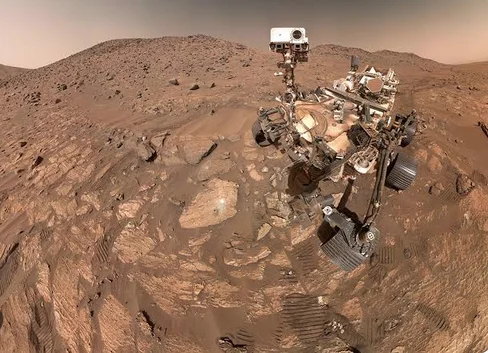
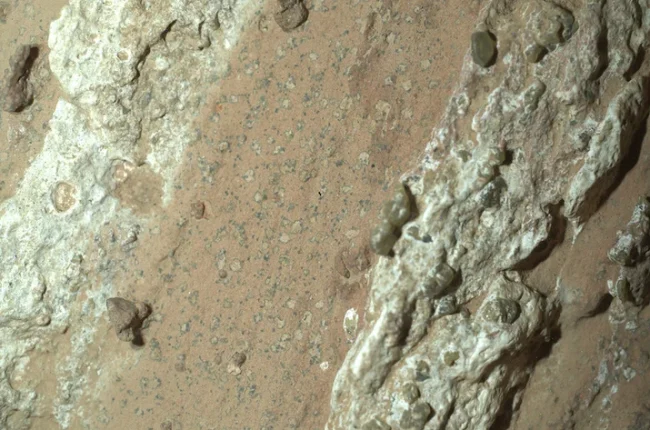
The Curiosity rover detected long hydrocarbon chains and other complex molecules in ancient rocks from Gale Crater. Shortly afterward, Perseverance found associations between minerals and carbon-rich compounds in Jezero Crater, as well as polycyclic aromatic hydrocarbons, molecules considered especially interesting for astrobiology.
These discoveries do not prove the existence of life. But they do show that Martian organic chemistry is much richer than previously thought.

Why Will Samples Brought Back to Earth Be So Important?
Astronomers argue that the next great revolution will come when Martian samples can be analyzed in laboratories on Earth.
The difference is enormous.
The instruments installed on a rover must be small, tough, and energy efficient. In a terrestrial laboratory, scientists can use far more powerful equipment, capable of detecting details that are impossible to observe from Mars.
In addition, experience gained from asteroid sample-return missions such as Hayabusa2 and OSIRIS-REx has shown that many extremely fragile molecules are only detected when the material is studied under controlled conditions.
That is why missions such as Tianwen-3, MMX, or a potential international Mars sample-return campaign are considered essential for advancing this research.
A New Way to Search for Life
The idea is especially interesting because it avoids relying on a single spectacular test.
Instead of looking for a “smoking gun,” the proposal is to reconstruct the entire history of Martian carbon.
Questions such as:
• What molecules currently exist on Mars?
• How were they formed?
• Do they come from asteroids and comets, or did they originate on the planet itself?
• How have they been modified over time?
can be answered even if a fossil organism is never found.
This strategy turns the search for life into a much broader study of planetary chemistry.
What’s at Stake
Beyond scientific curiosity, the outcome touches on a fundamental issue: our own origin.
The same kinds of molecules that have been detected in asteroids, comets, and meteorites may also have played a role in the emergence of life on Earth. If similar processes occurred on Mars, we could learn a great deal about how chemistry evolves toward ever more complex systems.
Even if Martian life is never discovered, understanding these reactions will help us better understand how life arose on Earth.
A Final Reflection
Perhaps the most important discovery will not be a perfectly preserved Martian microbe.
Perhaps the answer will emerge gradually, as we reconstruct the chemical history of a planet that once had rivers, lakes, and conditions favorable to life.
After all, detectives do not solve a case by finding a single clue. They do it by gathering many small pieces of evidence until the full story begins to make sense.
Mars may be waiting for exactly that kind of investigation. And who knows… maybe the molecules that today look like mere chemical leftovers will end up revealing that billions of years ago we were not alone in the Solar System.
What do you think? Do you believe the answers will come from fossils, present-day microorganisms, or from the detailed study of organic molecules? I’d love to hear your thoughts in the comments.
Deja una respuesta