This article is the English translation from Spanish of this other article
A universe that arouses curiosity
I was watching the Star Wars films with my son and I wondered: why not write a blog post about the astronomy in the films? There’s a lot of it. Since the first Star Wars film appeared in 1977, millions of people have looked at the night sky with a mixture of fascination and hope. Could there really be worlds like Tatooine, with two suns on the horizon? Are there icy planets like Hoth or endless jungles like those on Endor? The truth is that, although the saga was born from cinema and imagination, many of its ideas have firm roots in modern astronomy. And that’s precisely the beauty of it: Star Wars not only entertains, it also pushes us to look up and wonder if, somewhere in the cosmos, something similar could exist.
Tatooine and worlds with two suns
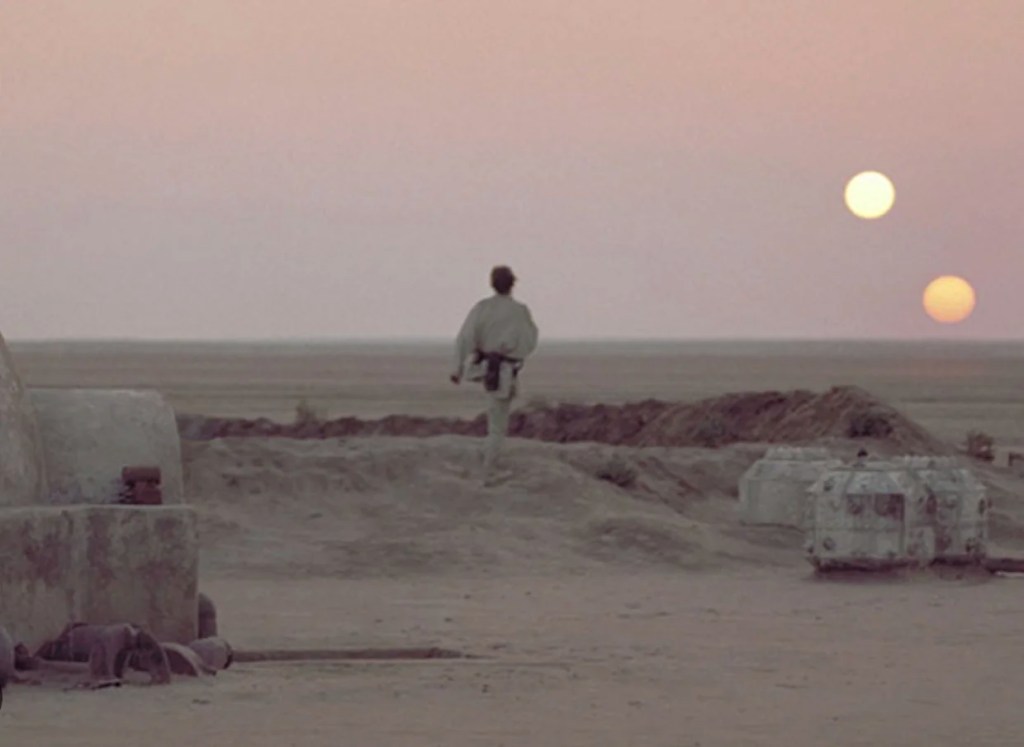
The image of Luke Skywalker watching the two suns set in the evening is one of the most iconic scenes in cinema. In the 1970s, having two suns was pure fantasy. Today, however, we know that binary planets are real. In fact, several worlds orbiting systems with two stars have been found. One of the first to be confirmed was Kepler-16b, a planet that revolves around two suns as if it were Tatooine’s scientific cousin. Of course, it’s not an ideal place to go on holiday—it’s probably a giant cold planet—but it shows that the scriptwriters weren’t so far off the mark. Once again, reality catches up with fiction… and surpasses it.
Hoth and the frozen planets
The frozen planet Hoth, the setting for the famous battle in The Empire Strikes Back, seems like something out of a polar dream. But do such worlds exist? Yes, and in abundance. We call them frozen exoplanets, worlds where temperatures are so low that water, carbon dioxide and even methane remain frozen. A nearby example would be Europa, one of Jupiter’s moons. Its surface is a crust of ice, but underneath it could hide a liquid ocean. No one knows if there is life there, but its icy landscape would not be out of place in a scene from Star Wars. Furthermore, Hoth reminds us that even the most inhospitable worlds can be beautiful, and that ice is also part of the history of the universe.

LEGO del Sistema Solar
Kit educativo de astronomía Technic. Incluye modelos del sistema solar, planetas detallados y herramientas para que chicos y grandes aprendan jugando. Ideal para despertar curiosidad científica, descubrir los secretos del cielo y fomentar el aprendizaje práctico de una forma divertida.
Endor and the endless forests
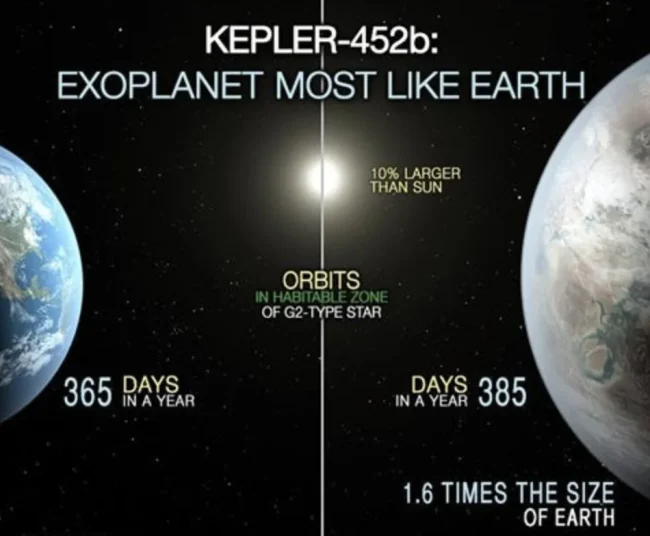
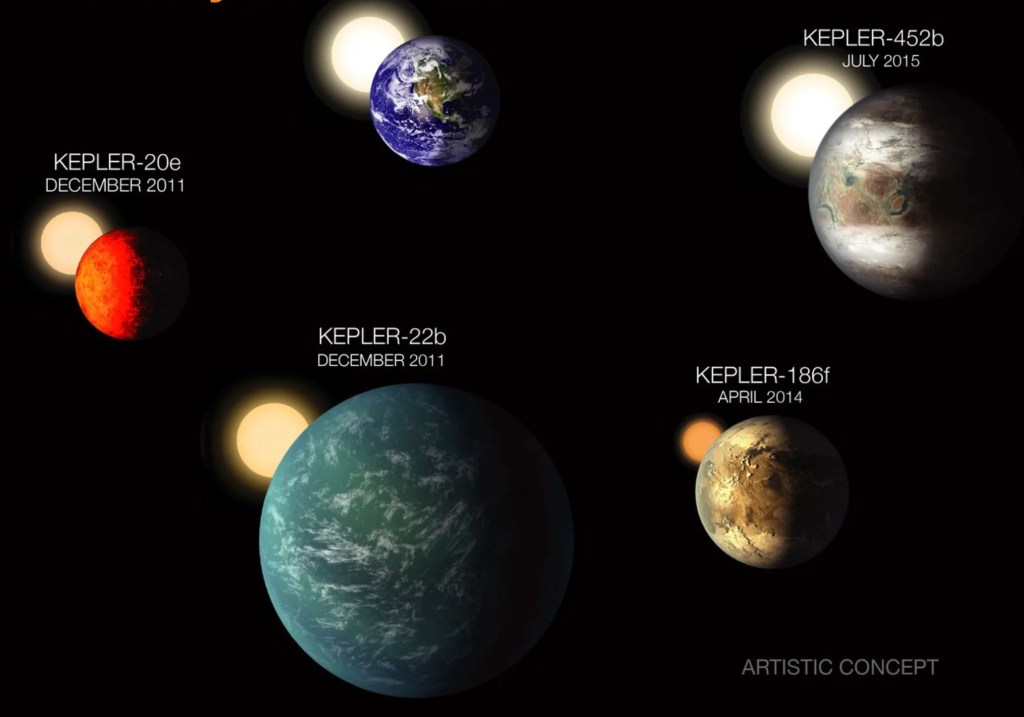
Endor, home to the friendly Ewoks, is a reminder that green worlds also have their charm. No planet like it has been found yet, but several potentially habitable exoplanets have been discovered in areas where liquid water and, perhaps, forests could exist. One of the most promising is Kepler-452b, about 1,400 light years away. Its size and distance from its star make it a larger cousin of Earth. We don’t know if it has trees, mountains or Ewoks, but it’s not too hard to imagine. We still can’t say if there are jungles under other stars, but each new discovery expands our catalogue of possible ‘Endors’. And that, for dreamers, is enough.
Ships and the speed of light
The Millennium Falcon travelling through hyperspace is an image etched in the minds of anyone who grew up with the saga. But, of course, the speed of light is an insurmountable limit. However, there are theories that flirt with the idea of ‘bridges’ in space-time, such as wormholes. These would be shortcuts that would allow travel between distant points without breaking the laws of relativity. No one has seen them, we don’t even know if they can really exist, but the concept has inspired both physicists and filmmakers. In a way, the hyperspace of Star Wars is a poetic version of these ideas. It is not an absolute impossibility.
Binary systems and inhabited moons
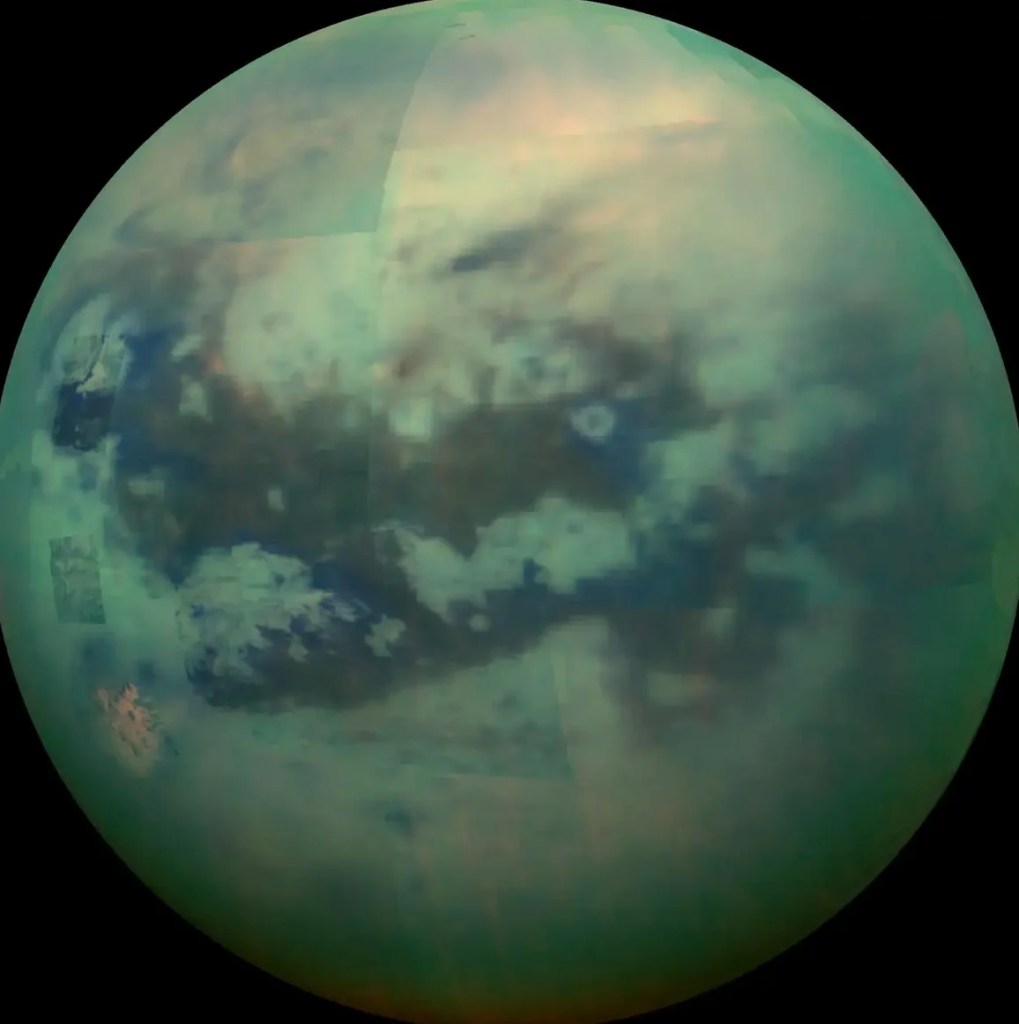
In the Star Wars galaxy, many bases and civilisations are located on moons. The Moon of Endor, for example, or Yavin 4, the hideout of the Rebel Alliance. This is not so far-fetched. In our solar system, there are moons that could be habitable, at least in theory. Titan, Saturn’s moon, has rivers and lakes of liquid methane. Europa, as we mentioned, could hide oceans under its ice. When we think of life beyond Earth, we tend to imagine planets. But perhaps the real gems are the moons. Maybe one day, if we travel far enough, we will find a real ‘Yavin 4’ where a civilisation hides among jungles and mists.
The power of the stars
The stars in Star Wars not only illuminate the backdrop of space, they are also a source of energy and destruction. The Death Star, for example, takes its name from these celestial bodies that give life… or take it away. In reality, there are equally impressive phenomena: supernovas, stellar explosions that release more energy in seconds than our Sun does in its entire lifetime. If a civilisation could harness that energy, it would have almost unimaginable power. On the other hand, researchers are studying so-called Dyson spheres, hypothetical megastructures capable of capturing the total energy of a star. They do not exist, but solar panels are a very small-scale version.
The landscapes of a possible galaxy
Something that has always distinguished Star Wars is its diversity of worlds: deserts, oceans, volcanoes, floating cities. The curious thing is that all of them reflect conditions that could actually exist in the universe. Exoplanets discovered by telescopes such as Kepler or TESS show us atmospheres of methane, iron rains, seas of lava and supersonic winds. They are so extreme that they almost seem invented by George Lucas. And yet, they are there. Orbiting distant stars. Shining like tiny points of light in the data detected by telescopes. It is as if the universe is striving to remind us that its imagination is undoubtedly vaster than ours.
When science and fiction meet together
The most beautiful thing about all this is how Star Wars and astronomy feed off each other. The films inspire scientific vocations, like mine. And real discoveries fuel new science fiction stories. Every time a telescope finds a new exoplanet, someone, somewhere, imagines a story that could happen there. Perhaps with heroes, robots and space battles. Or simply with beings who, like us, look up at their night sky and wonder what lies beyond. Because, in the end, both science and fiction are born from the same impulse: curiosity. That need to look at the unknown and try to understand it, even if it is with a torch made of dreams.
A galaxy not so far away
Star Wars does not set out to teach us physics. But it reminds us why we love to look at the stars. It brings back that childlike excitement of thinking that there might be something else out there. So, the next time you see the twin suns of Tatooine setting on the horizon, remember that the real universe is also full of incredible places waiting to be discovered. And who knows, maybe in a galaxy not so far away… someone is looking at us with the same curiosity.
Deja una respuesta