The original article was published in Spanish at:
https://todoastronomia.net/2026/09/25/el-agua-en-el-cometa-3i-atlas/
An Unexpected and Highly Revealing Visitor
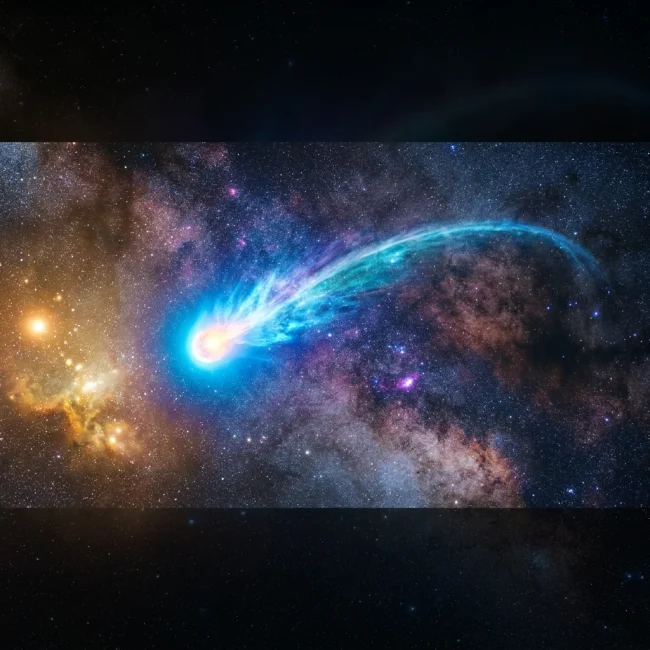
In July 2025, something extraordinary was detected: a comet that did not belong to the Solar System. It was moving too fast, followed an unusual trajectory, and was not gravitationally bound to the Sun. It had arrived from another star system. It was named 3I/ATLAS, and since then it has become a true scientific gem.
The Trick Lies in the Water
Scientists measured the ratio between ordinary hydrogen and deuterium, a heavier form of hydrogen. This D/H ratio acts like a chemical fingerprint. In 3I/ATLAS, the water contains 30 times more deuterium than Earth’s ocean water, and much more than the water in Solar System comets.

Why Is the Excess of Deuterium Important?
Deuterium becomes incorporated into water in extremely cold environments, below 30 kelvin, or about −240 °C. This suggests that 3I/ATLAS formed in an environment much colder and less irradiated than the one where the Solar System was born. Our planetary system formed in a relatively warm and active region, while the system of origin of 3I/ATLAS probably formed in a colder, quieter, and more isolated interstellar cloud.
Observing the Invisible with ALMA
Researchers used the ALMA radio telescope in Chile’s Atacama Desert. Although ordinary water vapor was not detected directly, related molecules such as heavy water (HDO) and methanol were observed, allowing scientists to infer how much water is present in the comet’s coma.

How 3I/ATLAS Changes Our View of the Solar System
This discovery confirms that deuterium-rich water exists in other planetary systems. It shows that water-formation processes vary greatly depending on the stellar environment, and reinforces the idea that the ingredients for planets—and perhaps life—are common, but do not share a universal history. Future interstellar comets may serve as natural probes for studying the Galaxy’s chemical diversity.

A Thoughtful Ending
For centuries, we have wondered where Earth’s water came from. Thanks to 3I/ATLAS, the question expands: how many different stories can water have across the Universe? This small comet, traveling for billions of years between stars, reminds us that the Galaxy is not only vast, but also profoundly diverse. Sometimes, all it takes is analyzing a drop of water—even if it comes from another star.
Deja un comentario