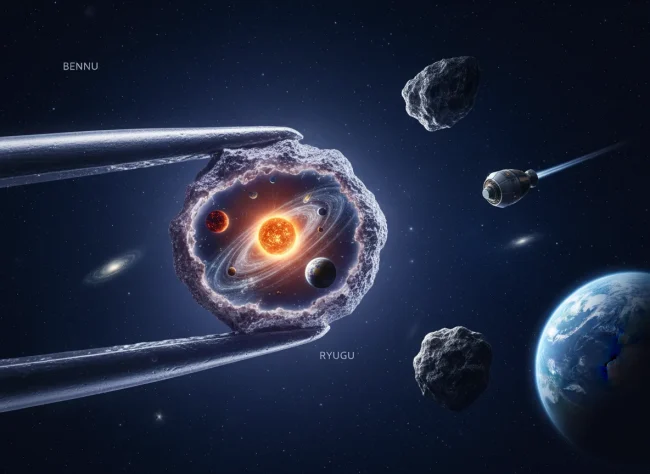
The original article was published in spanish at:
https://todoastronomia.net/2026/10/05/traer-asteroides-a-la-tierra/
Sometimes you have to bring a piece of space home
For decades, asteroids have been observed with telescopes, photographed by space probes, and even studied through meteorites that fell to Earth. Yet one question kept lingering: what information was being lost along the way?
The answer has come through sample-return missions. Instead of merely observing an asteroid from afar, some spacecraft have traveled to them, collected material, and brought it back to laboratories on Earth. The results have been so surprising that one idea has become firmly established: asteroids are genuine time capsules from the Solar System’s first millions of years.
Asteroids: the remnants of planet building
Before Earth, Mars, or Jupiter existed, an enormous cloud of dust and gas surrounded the young Sun. This material gathered into small bodies called planetesimals, the original “bricks” from which the planets were built. Many collided, grew, or were destroyed. Others survived.
Today’s asteroids are, to a great extent, those survivors. That is why they are so valuable: they allow us to study the earliest stages of planetary formation directly. You could say they are the oldest accessible fossils in the Solar System.
The problem with meteorites
It might seem that meteorites already provide samples of asteroids. And that is true, but there is an important drawback.
When a meteorite passes through Earth’s atmosphere, it is heated, altered, and contaminated. In addition, much of the information about its exact place of origin is lost. It is like finding a page torn from an ancient book: you can read part of the story, but you do not know which chapter it came from.
That is why samples collected directly from asteroids are so valuable. They are practically pristine materials, accompanied by geological context and detailed observations of the place where they were obtained.
Hayabusa: the mission that solved an old mystery
The first major revolution came with the Japanese Hayabusa mission, launched toward the asteroid Itokawa.
Although only about 90 milligrams of material returned to Earth, it was enough to resolve the so-called “ordinary chondrite paradigm.” For years, scientists thought that certain asteroids observed from Earth could not be the parent bodies of many meteorites. However, the samples showed that asteroid surfaces are modified by solar radiation and microscopic impacts, altering their appearance.
The problem was not the asteroids. It was how we were seeing them.
Ryugu and Bennu: the ingredients of life
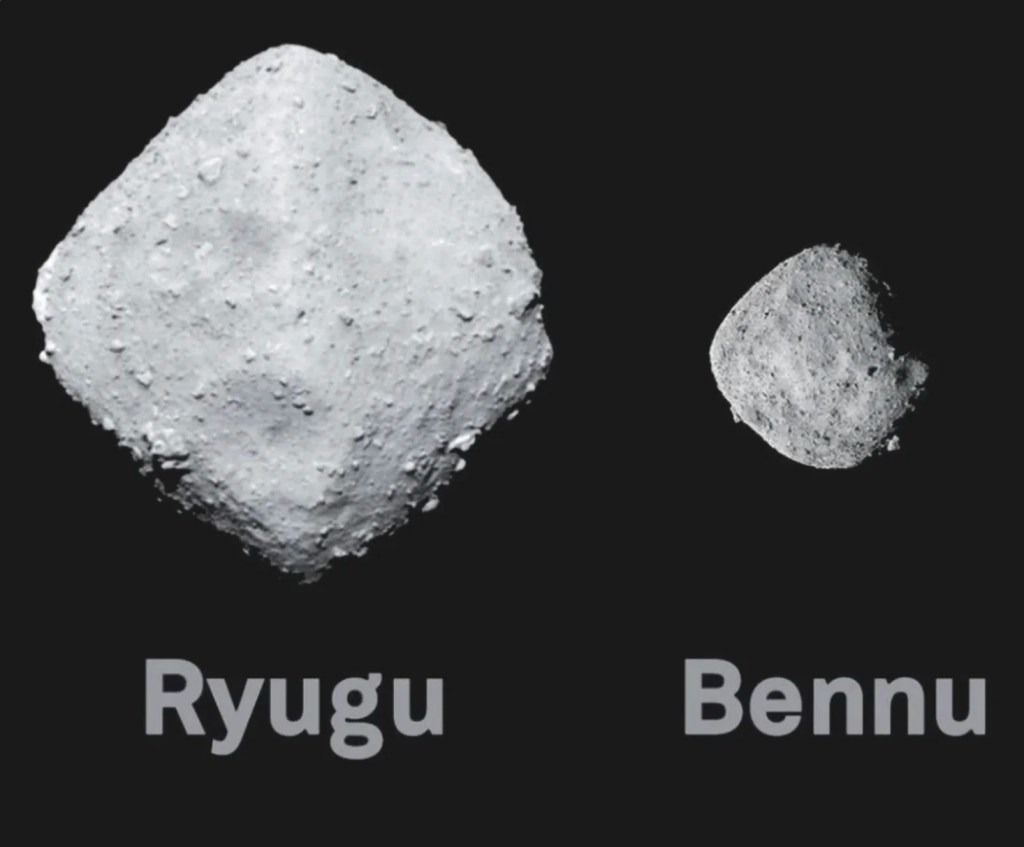
The Hayabusa2 and OSIRIS-REx missions took the investigation much further.
The asteroids Ryugu and Bennu showed clear evidence that they had hosted liquid water in the past. Researchers found hydrated minerals, carbonates, salts, and an extraordinary wealth of organic compounds.
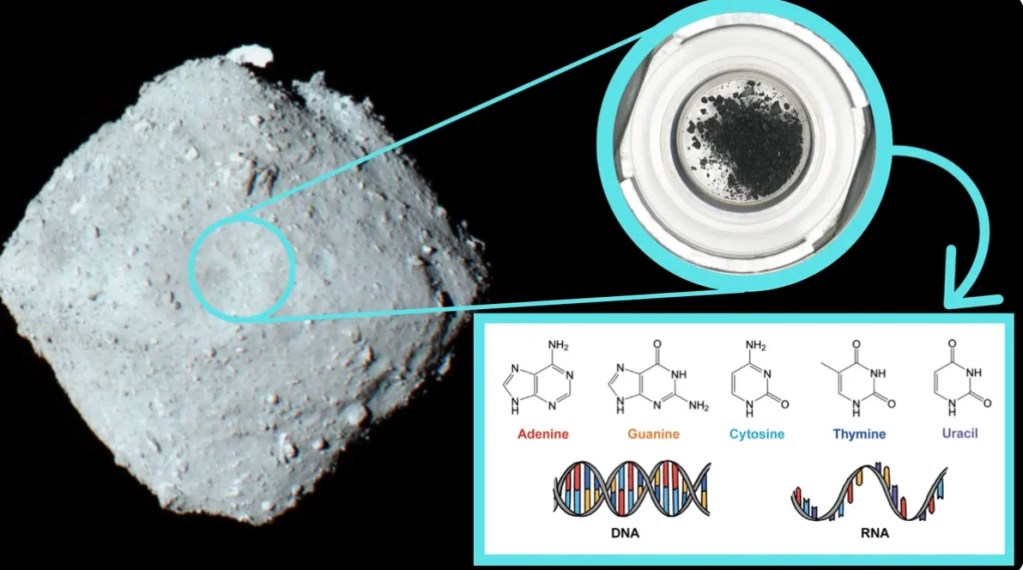
Thousands of different organic species were identified in samples from Ryugu. Numerous amino acids—fundamental components of the proteins used by terrestrial life—were found in Bennu.
This does not mean that life has been found on these asteroids. But it does show that the ingredients needed to build complex biological molecules may be far more widespread than previously thought.
Discoveries impossible to make with a telescope
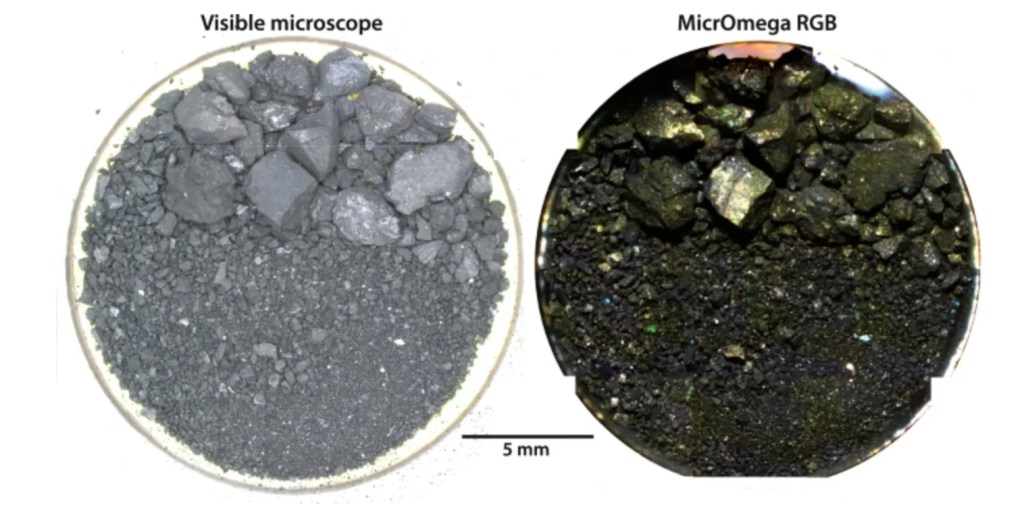
One of the most important findings was the detection of extremely fragile materials.
Salts and minerals never observed in meteorites appeared in Bennu. The reason is simple: when they enter the atmosphere and are exposed to Earth’s air and moisture, those minerals quickly disappear.
Without a sample-return mission, we would never have known they existed.
It is like trying to study a snowflake using only photographs taken after it has melted.
The next missions are already underway
Asteroid exploration is far from over.
Upcoming missions include:
• OSIRIS-APEX, which will visit the asteroid Apophis.
• Hayabusa2 Extended Mission, heading to asteroid 1998 KY26.
• Psyche, which will explore a possible exposed metallic core from an ancient protoplanet.
• MMX, which will bring back samples from Phobos, Mars’s mysterious moon.
The recent Tianwen-2 mission was sent to Earth’s quasi-satellite Kamoʻoalewa. We will talk about it another time.
Each mission addresses different questions about planetary formation, the evolution of Mars, the origins of Earth’s water, and even how we might defend ourselves against a possible future impact.
Asteroids and planetary defense
The importance of asteroids is not purely scientific.
The DART mission demonstrated in 2022 that an asteroid’s orbit can be changed through a controlled impact. That experiment marked the first real test of planetary defense in history.
Understanding what asteroids are made of is essential for knowing how they would respond if we ever needed to deflect one.
Not all asteroids respond in the same way. Some are compact blocks; others are genuine piles of rubble held together by their own gravity.
In the end, the story of our origins fits into a few grams of dust
It is fascinating to think that some of humanity’s biggest questions—how Earth formed, where its water came from, or how the molecules that led to life appeared—might be answered by analyzing just a few grams of rock brought from hundreds of millions of kilometers away.
Sample-return missions have shown that asteroids are much more than simple rocks wandering through space. They are extraordinarily ancient archives containing a record of the Solar System’s childhood.
And the best part is that we have only just begun to turn their pages.
What do you think the next major discovery will be: finding new prebiotic ingredients, better understanding the origin of Earth’s water, or discovering how Earth really formed? Tell me in the comments.
Deja un comentario